// The Ice and the Impossible
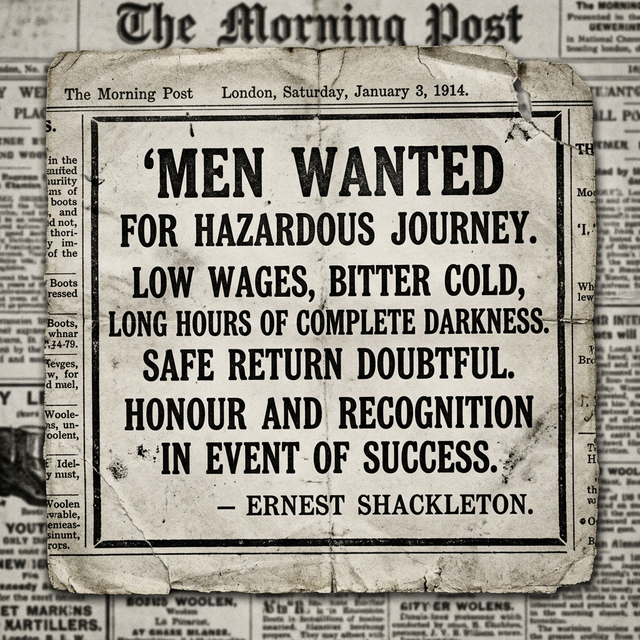
In August 1914, Ernest Shackleton sailed from London with 27 men and a singular ambition: the first land crossing of Antarctica. Within months, his ship Endurance was trapped in pack ice in the Weddell Sea. It drifted, imprisoned, for ten months before the pressure crushed it and she sank. What followed was a 22-month ordeal on ice floes, open lifeboats, and an uninhabited sub-Antarctic island — yet every single member of the expedition survived. Not one life was lost. There was no GPS, no satellite phone, no rescue service that could reach them. There was only Shackleton. The expedition's failure as an exploratory mission was total; its success as a leadership case study is without parallel in human history. The question for those of us navigating the comparatively more forgiving terrain of technology investing and company-building is: what exactly made him so effective?
// Leading Through Uncertainty
Shackleton's methods map with striking precision onto what modern research identifies as the hallmarks of effective leadership under uncertainty. He maintained relentless clarity of mission even as circumstances changed radically — the goal shifted from crossing Antarctica to getting every man home alive, and he made that pivot without hesitation or ego. He understood intuitively what organizational psychologists now call "psychological safety": he ate with his crew, worked alongside them, and refused to let status differentials calcify into distance. When skepticism arose he addressed it directly, sometimes pulling a potential mutineer into a tent for a private conversation, sometimes publicly redistributing burdens to demonstrate shared hardship. He also possessed an extraordinary capacity to read individual motivations — he knew which men needed encouragement, which needed distraction, and which needed responsibility. In the fast-moving tech industry, where companies routinely face compressed timelines, pivots forced by competitive dynamics, and the constant pressure of fundraising cycles, these skills are not soft — they are the primary determinant of whether a team holds together when conditions deteriorate.
// The PE-Backed Company in the AI Era
For management teams navigating PE-backed transformations — particularly those at the AI inflection point — the Shackleton lessons are practical, not merely inspirational. The most common failure mode we observe in portfolio companies is not strategic error; it is leadership entropy under pressure. When growth stalls, when a key customer churns, when a product launch fails, teams fragment along the fault lines that were always there but papered over in better times. Shackleton's genius was in designing systems — routines, rituals, humor, carefully assigned tasks — that kept entropy at bay. He understood that morale is a resource as finite and critical as food and fuel. The best technology executives we've partnered with share this quality: they treat culture not as a HR abstraction but as a competitive advantage that requires deliberate, daily investment. In the AI era, where the rate of change is genuinely unprecedented, the ability to maintain a high-trust, high-accountability team culture through turbulence may be the most durable source of edge that a company possesses. Shackleton never made it across Antarctica. But every single person who followed him into the ice came home. By the only measure that ultimately matters, he did not fail.
- Clarity of mission trumps consistency of plan — pivot the plan, never the purpose.
- Psychological safety is not a soft concept; it is the primary driver of team performance under pressure.
- Leaders must read individual motivations, not manage to the median.
- Morale is a finite resource — it requires deliberate, daily investment.
- Culture degrades fastest when leadership attention is most needed — build systems that hold without constant intervention.
// SOURCES & FURTHER READING
- Lansing, Alfred. Endurance: Shackleton's Incredible Voyage. Carroll & Graf, 1959. — The definitive first-person account of the expedition. [Book]
- Perkins, Dennis N. T. Leading at the Edge: Leadership Lessons from the Extraordinary Saga of Shackleton's Antarctic Expedition. AMACOM, 2000.
- Edmondson, Amy C. "Psychological Safety and Learning Behavior in Work Teams." Administrative Science Quarterly, 1999. [Journal]
- Harvard Business Review. "Leadership Lessons from the Shackleton Expedition." HBR, Dec 2000. [HBR]
- Morrell, Margot & Capparell, Stephanie. Shackleton's Way: Leadership Lessons from the Great Antarctic Explorer. Viking, 2001.